Welcome to the "Just Say NO" page designed to help you sort your way through Bad Contracts. There will be lots of links here for you to explore, and we'll keep adding more info, so visit often. This campaign was launched in 2018 by CMG Freelance, which was joined with colleagues at NPAC, PWAC, TMAC, and UWP to launch the Say NO to Bad Contracts campaign across Canada.
We hope you find this information useful. There is much more to come. And don't forget you can join CFG for just $150/year to get personal advice on your contracts, along with many other benefits.
First, some credit where credit is due. This campaign was in part inspired by The Born Freelancer, a frequent contributor to Story Board, our blog where we post many original stories about freelance life. This column, penned at the end of November 2017, contains some very sage advice, advice freelancers sometimes choose to ignore because, 'I need the money'. Fair enough. But do you need to get taken advantage of?
Here are a few main points to take away from the column:
"Only by being prepared to publicly walk away can we freelancers ever hope to achieve contractual fairness.
It is frightening to contemplate, especially if you have failed to develop multiple revenue streams (a must!) and everyone is urging you to just “suck it up” and accept that which you know to be unacceptable.
It’s impossible to prepare for the day you will choose to draw your line in the sand. It will be for different reasons for different people. But you will instinctively know deep inside. How you choose to proceed will potentially impact you and others for years to come.
Will it always result in an ideal outcome? Of course not. It is a last choice “nuclear option” when faced with unacceptable demands. But if more of us were less afraid to use it publicly when faced with unconscionable greed we might have to face such situations less frequently in future.
If walking away is our “nuclear option,” the alternative “conventional weapons option” is to band collectively together to improve our lot as working freelancers. I strongly urge you to consider joining a relevant guild or union even if you don’t see immediate benefits. If you join, they will come."
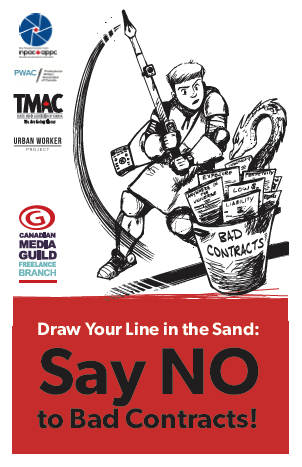
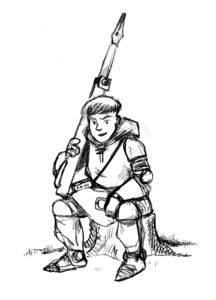
The second credit goes to the creator of our dashing 'Lancer you see above, Kevin Sylvester. Some of you may be familiar with Kevin's work as a national sportscaster and fill-in host on CBC Radio, but Kevin is also an author of both adult and children's books and in our humble opinion, a fine illustrator. Our 'Lancer, complete with GoPro, audio recorder and smartphone, is well-equipped to show people who commission your work by forcing you to sign unfair contracts that the pen is indeed mightier than the sword. Also thanks to designer Caroline Mitic for incorporating Kevin's 'Lancer illustrations into the Say NO to Bad Contracts brochure, which you can download here.
But you can read all of the content of the brochure right here:
Not only have rates been dropping, more and more contracts demand your copyright, moral rights, and contain onerous indemnification clauses. These clauses leave you on the hook for defending yourself against any legal claims, while it is most likely you worked with an entire team at the firm that contracted you to publish the final product. It's hardly your entire responsibility to shoulder the blame.
It's time to say NO to these contracts and make the contractors realize that they can't take advantage of you. We can help you understand the contracts and provide suggested alternative language.
[bg_faq_start] Before you even see a contract:
You should always get a written contact before you start work, and the terms of this contract should be negotiated fairly between you and the company. Employers/ engagers often present contracts like they are not a choice, but you always have the option of at least asking questions and suggesting changes.
If you don’t get a written contract before you start, send an email to the person who hired you confirming the details you agreed to verbally. This gives you an opportunity to correct any misunderstandings and a degree of comfort in knowing the basic terms of your employment.[bg_faq_end] [bg_faq_start]
Ideally, the amount you charge for your work will be somewhere in the range of these three figures. Keeping these numbers in mind will give you some idea of what your time, expertise and personal brand are worth in each situation.
Before you sign a contract, take time to consider which clauses you might want to get changed, ask someone else to take a look at it and sleep on it. Don’t feel rushed into signing something that makes you uncomfortable![bg_faq_end]
[bg_faq_start] Our Story Board site has published several stories about contracts.
Start here with Katie Lane, an American attorney who specializes in helping freelancers. Her blog post, "The Anatomy of a Contract" is a good read about what the purpose of a contract should be, and how you can avoid being taken advantage of in some of the basic sections.
This March 2018 article by Irene Wielawski for the Association of Health Care Journalists details why you should never sign a contract that has an indemnification clause in it, as well as some good tips on negotiation techniques in the sidebar.[bg_faq_end]
Here's a story from the Poynter Institute in 2015 about a legal action taken against a freelance writer who authored a piece in Forbes magazine. Don't let this happen to you!
When you are asked to sign a contract that basically puts all the liability and indemnity on you, especially when you are giving up ownership of your work, that's a big warning sign. Read this article from Sidebar Saturdays, a blog "Where the practice of law meets the profession of writing. Posted weekly by writers who are attorneys." They are mostly concerned with fiction writing, but this particular article can absolutely apply to non-fiction work.
Don't be afraid to ask for more money or better terms in your contract. Rachel Zamzow writes in The Open Notebook, a publication for science, environmental and health journalists, about how and why you should ask for better pay. Hint: Ask nicely and provide good reasons and your editor won't likely hold it against you.[bg_faq_end]
This is a fresher article on Reading and Negotiating your contracts. I only take issue with one aspect of the article and that's the attitude towards kill fees: 'A common kill fee rate is 25 percent of the total pay, though some journalists may negotiate a kill fee of up to 50 percent.' NO. If you've done 25% or 50% of the work and the story is killed, a quarter or half the fee is deserved. If you've completed all work on the assignment, there is no such thing as a kill fee. There is only THE FEE, which is 100% of what was promised to you for your completed work.
This article in CopyrightLaws.com lays out in fairly simple terms who owns copyright, including some examples regarding musicians and graphic designers, with applications across the realm of 'content creators'.
We hope you find this information useful. There is much more to come. And don't forget you can join CFG for just $150/year to get personal advice on your contracts, along with many other benefits.

